

History of Kenya
A part of Eastern Africa, the territory of what is known as Kenya has seen human habitation since the beginning of the Lower Paleolithic. The Bantu expansion from a West African centre of dispersal reached the area by the 1st millennium AD. With the borders of the modern state at the crossroads of the Bantu, Nilo-Saharan and Afro-Asiatic ethno-linguistic areas of Africa, Kenya is a truly multi-ethnic state. The Wanga Kingdom was formally establsihed in the late 17th century. The kingdom covered from the Jinja in Uganda to Naivasha in the East of Kenya. This is the first time the Wanga people and Luhya tribe were united and led by a centralized leader, a king, known as the Nabongo.
The European and Arab presence in Mombasa dates to the Early Modern period, but European exploration of the interior began in the 19th century. The British Empire established the East Africa Protectorate in 1895, from 1920 known as the Kenya Colony.
During the wave of decolonisation in the 1960s, Kenya gained independence from the United Kingdom in 1963, had Elizabeth II as its first head of state, and Jomo Kenyatta as its Prime Minister. It became a republic in 1964, and was ruled as a de facto one-party state by the Kenya African National Union (KANU), led by Kenyatta from 1964 to 1978. Kenyatta was succeeded by Daniel arap Moi, who ruled until 2002. Moi attempted to transform the de facto one-party status of Kenya into a de jure status during the 1980s, but with the end of the Cold War, the practices of political repression and torture which had been “overlooked” by the Western powers as necessary evils in the effort to contain communism were no longer tolerated in Kenya.
Moi came under pressure, notably by US ambassador Smith Hempstone, to restore a multi-party system, which he did by 1991. Moi won elections in 1992 and 1997, which were overshadowed by politically motivated killings on both sides. During the 1990s, evidence of Moi’s involvement in human rights abuses and corruption, such as the Goldenberg scandal, was uncovered. He was constitutionally barred from running in the 2002 election, which was won by Mwai Kibaki. Widely reported electoral fraud on Kibaki’s side in the 2007 elections resulted in the 2007–2008 Kenyan crisis. Kibaki was succeeded by Uhuru Kenyatta in the 2013 general election. There were allegations that his rival Raila Odinga actually won the contest, however, the Supreme Court through a thorough review of evidence adduced found no malpractice during the conduct of the 2013 general election both from the IEBC and the Jubilee Party of Uhuru Kenyatta.
Uhuru was re-elected in office five years later in 2017. His victory was however controversial. The supreme court had vitiated Uhuru win after Raila Odinga disputed the result through a constitutionally allowed supreme court petition. Raila Odinga would later boycott a repeat election ordered by the court, allowing Uhuru Kenyatta sail through almost unopposed with 98% of the vote.
Source Wikipedia
British rule (1895–1963)
East Africa Protectorate
In 1895 the British government took over and claimed the interior as far west as Lake Naivasha; it set up the East Africa Protectorate. The border was extended to Uganda in 1902, and in 1920 the enlarged protectorate, except for the original coastal strip, which remained a protectorate, became a crown colony. With the beginning of colonial rule in 1895, the Rift Valley and the surrounding Highlands became reserved for whites. In the 1920s Indians objected to the reservation of the Highlands for Europeans, especially British war veterans. The whites engaged in large-scale coffee farming dependent on mostly Kikuyu labour. Bitterness grew between the Indians and the Europeans.
This area’s fertile land has always made it the site of migration and conflict. There were no significant mineral resources—none of the gold or diamonds that attracted so many to South Africa.
Imperial Germany set up a protectorate over the Sultan of Zanzibar’s coastal possessions in 1885, followed by the arrival of Sir William Mackinnon’s British East Africa Company (BEAC) in 1888, after the company had received a royal charter and concessionary rights to the Kenya coast from the Sultan of Zanzibar for a 50-year period. Incipient imperial rivalry was forestalled when Germany handed its coastal holdings to Britain in 1890, in exchange for German control over the coast of Tanganyika. The colonial takeover met occasionally with some strong local resistance: Waiyaki Wa Hinga, a Kikuyu chief who ruled Dagoretti who had signed a treaty with Frederick Lugard of the BEAC, having been subject to considerable harassment, burnt down Lugard’s fort in 1890. Waiyaki was abducted two years later by the British and killed.
Following severe financial difficulties of the British East Africa Company, the British government on 1 July 1895 established direct rule through the East African Protectorate, subsequently opening (1902) the fertile highlands to white settlers.
A key to the development of Kenya’s interior was the construction, started in 1895, of a railway from Mombasa to Kisumu, on Lake Victoria, completed in 1901. This was to be the first piece of the Uganda Railway. The British government had decided, primarily for strategic reasons, to build a railway linking Mombasa with the British protectorate of Uganda. A major feat of engineering, the “Uganda railway” (that is the railway inside Kenya leading to Uganda) was completed in 1903 and was a decisive event in modernising the area. As governor of Kenya, Sir Percy Girouard was instrumental in initiating railway extension policy that led to construction of the Nairobi-Thika and Konza-Magadi railways.
Some 32,000 workers were imported from British India to do the manual labour. Many stayed, as did most of the Indian traders and small businessmen who saw opportunity in the opening up of the interior of Kenya. Rapid economic development was seen as necessary to make the railway pay, and since the African population was accustomed to subsistence rather than export agriculture, the government decided to encourage European settlement in the fertile highlands, which had small African populations. The railway opened up the interior, not only to the European farmers, missionaries and administrators, but also to systematic government programmes to attack slavery, witchcraft, disease and famine. The Africans saw witchcraft as a powerful influence on their lives and frequently took violent action against suspected witches. To control this, the British colonial administration passed laws, beginning in 1909, which made the practice of witchcraft illegal. These laws gave the local population a legal, nonviolent way to stem the activities of witches.
By the time the railway was built, military resistance by the African population to the original British takeover had petered out. However new grievances were being generated by the process of European settlement. Governor Percy Girouard is associated with the debacle of the Second Maasai Agreement of 1911, which led to their forceful removal from the fertile Laikipia plateau to semi-arid Ngong. To make way for the Europeans (largely Britons and whites from South Africa), the Maasai were restricted to the southern Loieta plains in 1913. The Kikuyu claimed some of the land reserved for Europeans and continued to feel that they had been deprived of their inheritance.
In the initial stage of colonial rule, the administration relied on traditional communicators, usually chiefs. When colonial rule was established and efficiency was sought, partly because of settler pressure, newly educated younger men were associated with old chiefs in local Native Councils.
In building the railway the British had to confront strong local opposition, especially from Koitalel Arap Samoei, a diviner and Nandi leader who prophesied that a black snake would tear through Nandi land spitting fire, which was seen later as the railway line. For ten years he fought against the builders of the railway line and train. The settlers were partly allowed in 1907 a voice in government through the legislative council, a European organisation to which some were appointed and others elected. But since most of the powers remained in the hands of the Governor, the settlers started lobbying to transform Kenya in a Crown Colony, which meant more powers for the settlers. They obtained this goal in 1920, making the Council more representative of European settlers; but Africans were excluded from direct political participation until 1944, when the first of them was admitted in the council.
First World War
Kenya became a military base for the British in the First World War (1914–1918), as efforts to subdue the German colony to the south were frustrated. At the outbreak of war in August 1914, the governors of British East Africa (as the Protectorate was generally known) and German East Africa agreed a truce in an attempt to keep the young colonies out of direct hostilities. However Lt Col Paul von Lettow-Vorbeck took command of the German military forces, determined to tie down as many British resources as possible. Completely cut off from Germany, von Lettow conducted an effective guerilla warfare campaign, living off the land, capturing British supplies, and remaining undefeated. He eventually surrendered in Zambia eleven days after the Armistice was signed in 1918. To chase von Lettow the British deployed Indian Army troops from India and then needed large numbers of porters to overcome the formidable logistics of transporting supplies far into the interior by foot. The Carrier Corps was formed and ultimately mobilised over 400,000 Africans, contributing to their long-term politicisation.
Source Wikipedia

Africa: Misunderstood, Undervalued, and Strategically Vital
For decades, Africa has been portrayed as small, insignificant, and dependent — politically, intellectually, and economically. But the reality is far more complex, and far more powerful, than [...]

An Insight into the Life of Veronica Pickering, Community Advocate
Veronica is an astonishing, outstanding and inspiring lady. Her zests for life and ability to achieve at the highest level is simply amazing and very encouraging for [...]
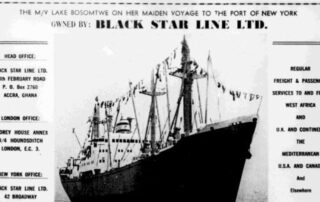
Black Star of Africa
Ghana Black Star NetworkThe Black Star of Africa is a black five-pointed star (★) symbolizing Africa in general and Ghana in particular. The Black Star Line, founded in 1919 by Marcus Garvey [...]


