
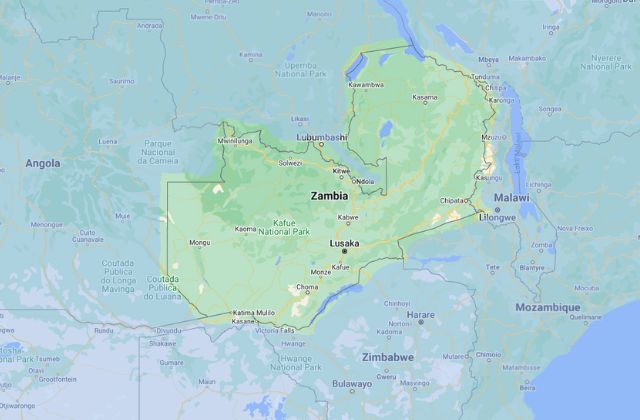
The British government hoped to increase white settlement as part of a wider strategy to strengthen British influence between South Africa and Kenya. Land was reserved for white ownership along the railway line, in the far north, and in the east.
Zambia was part of the British Empire, when it was known as Northern Rhodesia, until its independence from the United Kingdom in 1964. Both countries are part of the Commonwealth of Nations.
For most of this time, Zambia was a victim of exploitation by the British and its settler-colonial collaborators, whose absolute power allowed for unlimited lead mining and general extraction without any environmental standards.
The territory of Zambia was known as Northern Rhodesia from 1911 to 1964. It was renamed Zambia in October 1964 on its independence from British rule.
General elections were held in Zambia on 5 December 1973. They were the first elections held since the country was formally declared a one-party state in August, with the United National Independence Party (UNIP) as the only legally permitted party.
Source Wikipedia

Africa: Misunderstood, Undervalued, and Strategically Vital
For decades, Africa has been portrayed as small, insignificant, and dependent — politically, intellectually, and economically. But the reality is far more complex, and far more powerful, than [...]

Johnathon Kruger’s Journey Through Zambia’s Military History
Jonathan relays some chilling stories that he gained from conversing and sharing the latter years of some very brave World War 2 soldiers. From the involuntary [...]
Black Star of Africa
Ghana Black Star NetworkThe Black Star of Africa is a black five-pointed star (★) symbolizing Africa in general and Ghana in particular. The Black Star Line, founded in 1919 by Marcus Garvey [...]


