


Marian Rogers Croak
Marian Rogers Croak is a Vice President of Engineering at Google. She was previously the Senior Vice President of Research and Development at AT&T. She holds more than 200 patents.
She was inducted into the Women in Technology International Hall of Fame in 2013. In 2022, Croak was inducted into the National Inventors Hall of Fame for her patent regarding VoIP (Voice over Internet Protocol) Technology. She is one of the first two Black women to receive that honor, along with Patricia Bath. Her invention allows users to make calls over the internet instead of a phone line. Today, the widespread use of VoIP technology is vital for remote work and conferencing.[3]
She started off in Bell’s Human Factors division, with the specific purpose of studying how technology could be used to positively impact human’s lives. Croak first began working on digital messaging applications, tasked with the study of determining if various messaging applications could communicate with each other. This kind of research was very novel, as the earliest form of the Internet would not come to full fruition until the next year in 1983. Bell Labs wanted to send voice, text, and video data digitally rather than using a standard phone line. And the favored mechanism for this was Asynchronous Transfer Mode (ATM) protocol, but Croak, along with the rest of her team, convinced AT&T to use TCP/IP instead. TCP/IP allowed for a standardized way of packaging and communicating information
Conclusion
Voice over Internet Protocol is technology is an invention that is taken for granted by millions of people worldwide. To be able to communicate in this way, free of charge, is quite a phenomenon, and huge Marian for her invention.
Editor’s Note
It is great to know that such an invention and contribution to the world of technology is by a black woman.
Source: Wikipedia
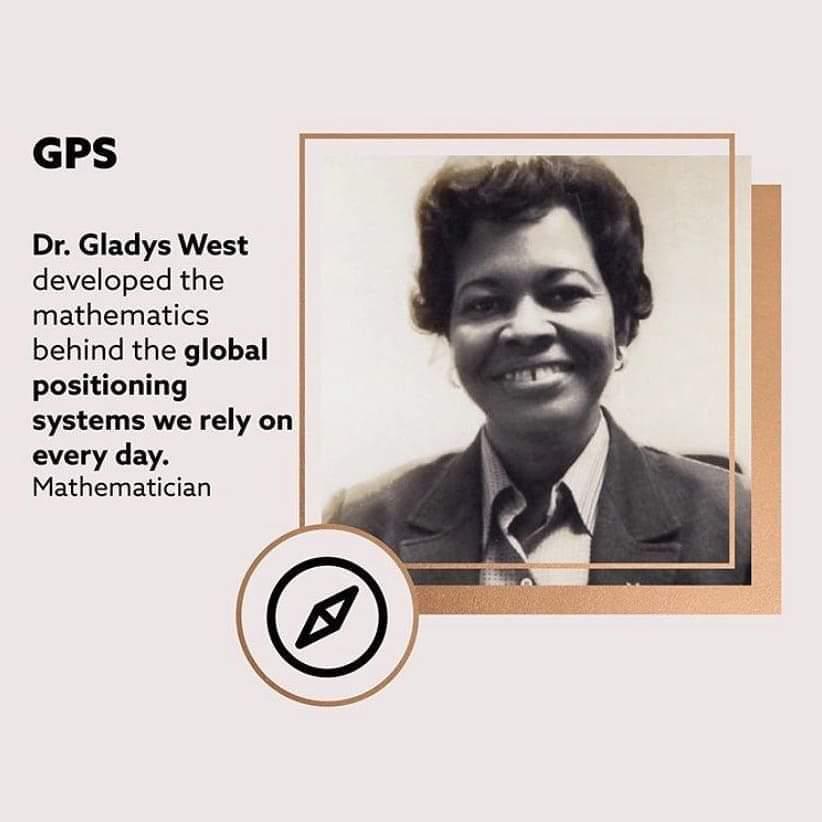
Dr. Gladys West
If you rely on your GPS for directions, you can thank a mathematician whose little-known contributions to the mathematical modeling of the Earth recently earned her one of the U.S. Air Force’s highest honors: induction into the Space and Missile Pioneers Hall of Fame! Dr. Gladys West, like the “human computers” at NASA who became famous with the book Hidden Figures, began her career by performing the complex hand calculations required before the computer age. However, her greatest accomplishment was the creation of an extremely detailed geodetic model of the Earth which became the foundation for the Global Positioning System. Although GPS is ubiquitous today, West says that in the moment, she wasn’t thinking about the future: “When you’re working every day, you’re not thinking, ‘What impact is this going to have on the world?’” she says. “You’re thinking, ‘I’ve got to get this right.'”
West was born on October 27, 1930 in a rural Virginia community of sharecroppers, but from an early age she had ambition to go beyond farm or factory work. “I thought at first I needed to go to the city. I thought that would get me out of the country and out of the fields,” she remembers. “But then as I got more educated, went into the higher grades, I learned that education was the thing to get me out.” West was valedictorian in her high school, which won her a scholarship to attend Virginia State College. There, she became one of only a handful of women studying mathematics. “You felt a little bit different,” she later reflected. “You didn’t quite fit in as you did in home economics.” West taught for several years after graduation and then accepted a position at the Naval Surface Warfare Center in Dahlgren, Virginia in 1956 — only the second black woman they had ever hired — analyzing data from satellites.
At first, that meant math on paper: “We would come in and sit at our desks and we would logic away, go through all the steps anyone would have to do to solve the mathematical problem.” But when computers entered the scene, it meant learning how to program — and being ready to catch the computers’ mistakes. “Nine times out of 10 they weren’t completely right,” she recalls, “so you had to analyze them and find out what was different to what you expected.” West was involved in an award-winning astronomical study in the early 1960s that showed how Pluto moved relative to Neptune, and her department head recommended her for a new role as project manager for the Seasat radar altimetry project, involving the first Earth-orbiting satellite that could remotely sense oceans.
The Seasat project became the jumping off point for further satellite modeling of the globe, and from the mid 1970s through the 1980s, West worked on programming an IBM 7030 “Stretch” computer with increasingly refined algorithms. She was then able to create an extremely accurate geodetic Earth model, even factoring in details like gravitational and tidal forces that slightly change the Earth’s shape. This model would later become the foundation for the GPS satellite system, which is widely used today for countless applications from navigation to communication. However, after West retired from her post in 1998, her contributions to GPS were largely forgotten.
West wasn’t idle in retirement, although a stroke temporarily slowed her down. While she was recovering, she set a new goal: “all of a sudden, these words came into my head: ‘You can’t stay in the bed, you’ve got to get up from here and get your PhD.'” She became Dr. West in 2018, thanks to a remote studies program with Virginia Tech. Then, her story resurfaced after she wrote a short biography for an Alpha Kappa Alpha sorority event recognizing senior members of the group. Fellow member Gwen James, who had known West for fifteen years, was amazed to hear about her friend’s career, and quickly started spreading the word: “I think her story is amazing.”
In 2017, Captain Godfrey Weekes, then the commander of the Dahlgren Division, wrote an article for Black History Month about the “integral role” West played in the development of GPS, observing that “she rose through the ranks, worked on the satellite geodesy, and contributed to the accuracy of GPS and the measurement of satellite data. As Gladys West started her career as a mathematician at Dahlgren in 1956, she likely had no idea that her work would impact the world for decades to come.” On December 6, 2018, West was inducted into the U.S. Air Force’s Hall of Fame in a ceremony in her honor at the Pentagon; the Air Force hailed her as one of “the leaders of the early years of the Air Force space program.” West says that she hopes her example will inspire another generation of female pioneers. “I think I did help,” she reflects. “The world is opening up a little bit and making it easier for women. But they still gotta fight.”
Conclusion
To create the foundation of the Global Positioning System which is used by millions of people worldwide is staggering. That fact that such an accomplishment can be attributed to a black woman is even more remarkable.
Editor’s Note
Dr Gladys West’s accomplishment of the foundation of the GPS should be common knowledge in the education system, but I do not believe it is, not anywhere near that it should be.
Source: Wikipedia
Marian Rogers Croak
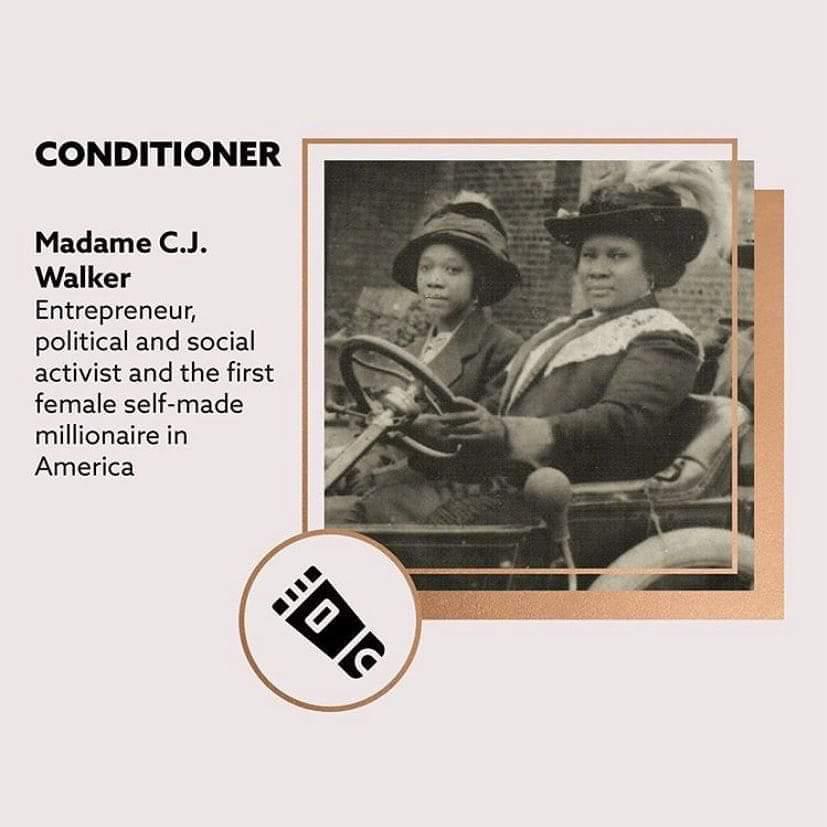
Madam C. J. Walker (born Sarah Breedlove; December 23, 1867 – May 25, 1919) was an American entrepreneur, philanthropist, and political and social activist. She is recorded as the first female self-made millionaire in America in the Guinness Book of World Records. Multiple sources mention that although other women (like Mary Ellen Pleasant) might have been the first, their wealth is not as well-documented Walker made her fortune by developing and marketing a line of cosmetics and hair care products for black women through the business she founded, Madam C. J. Walker Manufacturing Company. She became known also for her philanthropy and activism. She made financial donations to numerous organizations such as the NAACP, and became a patron of the arts. Villa Lewaro, Walker’s lavish estate in Irvington, New York, served as a social gathering place for the African-American community. At the time of her death, she was considered the wealthiest African-American businesswoman and wealthiest self-made black woman in America. Her name was a version of “Mrs. Charles Joseph Walker”, after her third husband.
Conclusion
To be in the Guinness Book of Record as the first black female self-made millionaire in America is most notable.
Editor’s Note
Madame Walker must have been an extremely determined black woman, especially in the face of raw racism that existed in the United States.
Source: Wikipedia
Mary Beatrice Davidson Kenner
Mary is an inventor of numerous products we use today and has the most patents of any African American woman. Kenner was born on May 17, 1912, in Monroe, North Carolina. Her father was inventor Sidney Nathaniel Davidson, and her mother is unknown to the public records; she has one sibling, her sister, Mildred Davidson Austin Smith.
Kenner patented multiple inventions in her ’40s, however, she began inventing at age six when she attempted to invent a self-oiling door hinge. Invention ran in the family. Her maternal grandfather Robert Phromeberger’s most notable inventions were a tricolor light signal for trains and a stretcher with wheels for ambulances. In 1914, her father patented a clothes presser that could fit in a suitcase. In 1980, her sister invented “Family Treedition,” a family board game.
Mary Kenner had many ideas as a child, including a convertible roof that would go over the folding rumble seat of the car, a sponge tip at the end of an umbrella that would soak up rainwater, and a portable ashtray that would attach itself to a cigarette pack. When her family moved to Washington D.C. in 1924, she walked the halls of the U.S. Patent and Trademark Office to become familiar with the building and the patent process.
In 1931, Kenner graduated from Dunbar High School and started attending Howard University but dropped out after a year and a half for financial reasons. She then took multiple odd jobs, and in 1941, she became a federal employee, remaining there during the rest of the decade. In 1950, she became a professional florist and ran her flower shop into the 1970s while inventing things in her spare time.
Kenner’s first patent was in 1957 for the sanitary belt. While she originally invented the sanitary belt in the 1920s, she couldn’t afford a patent. Over time she improved her earlier version and other versions that were patented before hers. The sanitary belt aimed to prevent the leakage of menstrual blood on clothing, which was a common problem for women at the time. The Sonn-Nap-Pack Company got word of this invention in 1957 and contacted her intending to market her invention, however when they discovered that she was Black, they declined. Beltless pads were invented in the 1970s and, as tampons became more popular, women stopped using sanitary belts.

Conclusion
Mary was a prolific inventor who started at age 6. She was clearly influenced by other members of her immediate and extended family, including father and grandmother. The typical world of racism meant that her sanitary belt invention was not taken as planned after the company found out that she was black.
Editor’s Note
The world is still in a state of imbalance due to racism. It is bad enough to have a class system but to have racism in the mix can be extremely difficult to contend with in the process of developing your God given talent.
Source: Wikipedia

Shirley Ann Jackson
Shirley Ann Jackson, FREng (born August 5, 1946) is an American physicist, and was the 18th president of Rensselaer Polytechnic Institute. She is the first African American woman to have earned a doctorate at the Massachusetts Institute of Technology (MIT) in Theoretical Elementary Particle Physics, and the first African American woman to have earned a doctorate at MIT in any field. She is also the second African American woman in the United States to earn a doctorate in physics.
Jackson was born in Washington, D.C., and attended Roosevelt Senior High School. After graduation in 1964, she enrolled at MIT to study theoretical physics, earning her B.S. degree in 1968.
Jackson elected to stay at MIT for her doctoral work, and received her Ph.D. degree in nuclear physics in 1973, the first African American woman to earn a doctorate degree from MIT. Her research was directed by James Young, a professor in the MIT Center for Theoretical Physics.[4][6] Jackson is also the second African American woman in the United States to earn a doctorate in physics. She was featured on the PBS show “Finding Your Roots” Season 6 Episode 7, where she is noted as one of the leading global pioneers in science all while knowing little about her ancestry. In 2002, Discover magazine recognized her as one of the 50 most important women in science.
Jackson joined the Theoretical Physics Research Department at AT&T Bell Laboratories in 1976, examining the fundamental properties of various materials. She began her time at Bell Labs by studying materials to be used in the semiconductor industry. She worked in the Scattering and Low Energy Physics Research Department from 1978, and moved to the Solid State and Quantum Physics Research Department in 1988. At Bell Labs, Jackson researched the optical and electronic properties of two-dimensional and quasi-two-dimensional systems.
Jackson served on the faculty at Rutgers University in Piscataway and New Brunswick, New Jersey from 1991 to 1995, in addition to continuing to consult with Bell Labs on semiconductor theory.[8] Her research during this time focused on the electronic and optical properties of two-dimensional systems.
Conclusion
Shirley Ann must have been extremely proud to have been the first black African American woman to have earned a doctorate at the Massachusetts Institute of Technology (MIT) in Theoretical Elementary Particle Physics.
Editor’s Note
Ladies such as Shirley Ann were trailblazer who achieved far beyond expectations of most American people.
Source: Wikipedia
Sarah Boone
Sarah Boone (née Sarah Marshall; c. 1832 – 1904) was an African-American inventor. On April 26, 1892, she obtained United States patent number 473,563[1] for her improvements to the ironing board. Boone’s ironing board was designed to improve the quality of ironing the sleeves and bodies of women’s garments. The ironing board was very narrow, curved, and made of wood. The shape and structure allowed it to fit a sleeve and it was reversible, so one could iron both sides of the sleeve.
Boone is regarded as the second African-American woman to attain a patent, after Judy Reed. Along with Miriam Benjamin, Ellen Eglin, and Sarah Goode, Boone was a pioneering African-American woman inventor who developed new technology for the home.
Conclusion
The ironing boar is such a fundamental household item that is taken for granted as to origin. The fact that Sarah Boone, a black female, help to creat such a useful domestic apparatus is outstanding.
Editor’s Note
Many items in the household are used without given any thoughts about how they were invented. They are used daily to achieve our objectives but it certainly worth know their origin, especially when they are part the contribution of a black person. It is I portant to give credit where it’s due.
Source: Wikipedia


Lisa Gelobter
Lisa Gelobter (born 1971) is a computer scientist, technologist and chief executive. She was the Chief Digital Service Officer for the United States Department of Education.
In 2016, Gelobter founded and took on the role of Chief Executive Officer of tEQuitable, a start-up that provides an independent and confidential platform to address issues of bias, harassment, and discrimination in the workplace. She raised more than $2 million for tEQuitable, becoming one of the only thirty-four Black women to ever raise $1 million or more in venture capital.
Her father was a Polish Jew, and her mother was Afro-Caribbean. She graduated from Brown University in 2011 with a computer science degree with a concentration in artificial intelligence and machine learning.
Conclusion
It is extremely important to have equitable working conditions because for many reasons, especially as so much of the working life of an individual is spent working for a living. Lisa was instrumental in addressing issues of bias, harassment and discrimination in the workplace.
Editor’s Note
Issues in the workplace is still a matter of concern for many employees and employers. It can be devastating for individuals who find themselves in such situations. So very well done to Sarah for making the world of work a better environment.
Source: Wikipedia
Alice H. Parker
Alice H. Parker was a Black inventor in the early 20th-century, best known for patenting a central heating system that uses natural gas. Her invention played a key role in the development of the heating systems we have in our homes today.
Alice H. Parker (A. Cer 1910), a Howard University graduate, invented the gas heater, a model now used in modern, central heating techniques for buildings. Parker achieved this feat after her journey on Georgia Avenue before impacting the world.
Conclusion
What an impact that Alice Parker has had on the world by inventing a central heating system, the gas heater. To have her invention used in the modern central heating techniques for buildings is immense.
Editor’s Note
When most people switch on the central heating to bring warmth and comfort in the depths of winter they are, I believe, totally unaware that it was invented by a black female. Education, education, education.
Source: Wikipedia

Marie Van Brittan Brown
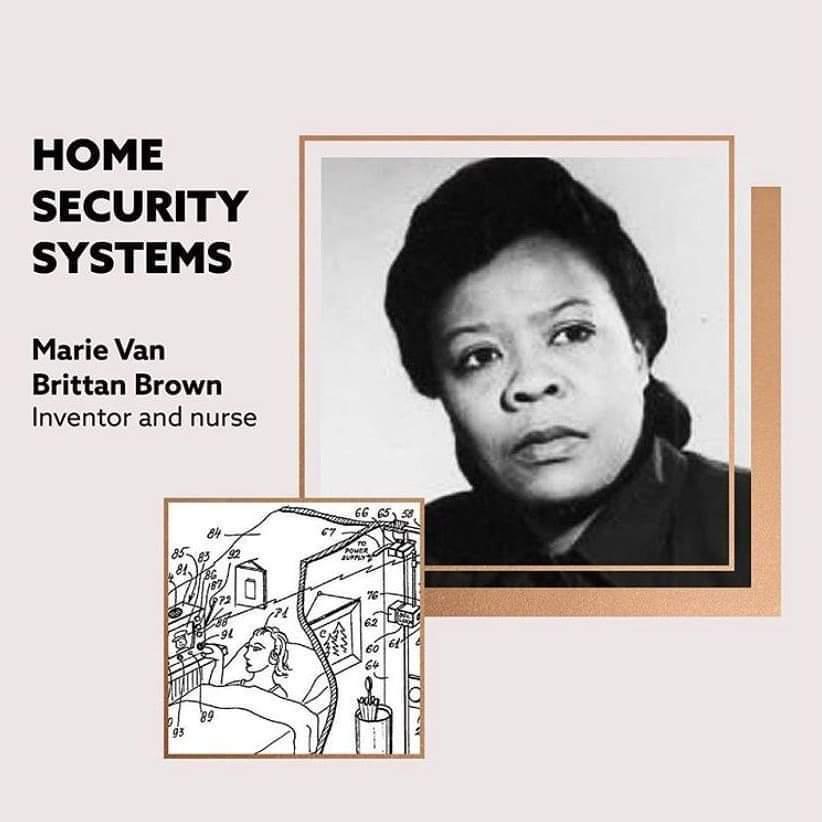
Marie Van Brittan Brown (October 30, 1922 – February 2, 1999) was an American nurse, her husband Albert L. Brown, an electronics technician. In 1966 they invented an audio-visual home security system. That same year they applied for a patent for their security system. It was granted three years later in 1969.
Marie Van Brittan Brown’s father was born in Massachusetts and her mother was from Pennsylvania. Both were African-American. Marie was born in Jamaica, Queens, New York.
Marie married Albert L. Brown, also African-American. The couple lived at 151–158 & 135th Avenue in Jamaica, Queens, New York. She had no siblings. Marie and Albert had two children. Their daughter also became a nurse and inventor.[6]
Marie died in Queens on February 2, 1999 aged seventy-six.
Conclusion
The audio-visual home security system is a great and ingenious device. To learn that it was developed by Marie Brown, a black female, is an absolute credit to her.
Editor’s Note
The home security is so important and widely used in that it provides so much protection and comfort to everyone, in particular vulnerable people. Total credit to Marie for such an ingenious system that afford us such a degree of comfort in our homes.
Source: Wikipedia
Valerie L. Thomas
Valerie L. Thomas (born February 8, 1943) is an American data scientist and inventor. She invented the illusion transmitter, for which she received a patent in 1980. She was responsible for developing the digital media formats that image processing system used in the early years of NASA’s Landsat program.
Thomas began working for NASA as a data analyst in 1964. She developed real-time computer data systems to support satellite operations control centers (1964–1970). She oversaw the creation of the Landsat program. Her participation in this program expanded upon the works of other NASA scientists in the pursuit of being able to visualize Earth from space.
In 1974, Thomas headed a team of approximately 50 people for the Large Area Crop Inventory Experiment (LACIE), a joint effort with the NASA Johnson Space Center, the National Oceanic and Atmospheric Administration (NOAA), and the U.S. Department of Agriculture. LACIE demonstrated the feasibility of using satellites to automate the process of predicting wheat yield on a worldwide basis.[8]
She attended a science exhibition in 1976 that included an illusion of a light bulb that appeared to be lit, even though it had been removed from its socket. The illusion, which involved another light bulb and concave mirrors, inspired Thomas. In response to her curiosity, she began her researching a potential patent in 1977. This involved creating an experiment in which she observed how the position of a concave mirror would affect the real object that is reflected through it. Through her discovery and experimentation, she would invent an optical device called the illusion transmitter. On October 21, 1980, she obtained the patent for the illusion transmitter, a device NASA currently used and has been adapted for screens on various devices ranging from surgery tools to televisions. Thomas became associate chief of the Space Science Data Operations Office at NASA. Thomas’s invention has been depicted in a children’s fictional book, television, and in video games.

In 1985, as the NSSDC Computer Facility manager, Thomas was responsible for a major consolidation and reconfiguration of two previously independent computer facilities. She then served as the Space Physics Analysis Network (SPAN) project manager from 1986 to 1990 during a period when SPAN underwent a major reconfiguration and grew from a scientific network with approximately 100 computer nodes to one directly connecting approximately 2,700 computer nodes worldwide. Thomas’ team was credited with developing a computer network that connected research stations of scientists from around the world to improve scientific collaboration.
In 1990, SPAN became a major part of NASA’s science networking and today’s Internet. She also participated in projects related to Halley’s Comet, ozone research, satellite technology, and the Voyager spacecraft.
She mentored students in the Mathematics Aerospace Research and Technology Inc. program. Thomas often spoke to groups of students from elementary school, secondary, college, and university ages, as well as adult groups. As a role model for her community, she visits schools and national meetings over the years. She has mentored students working in summer programs at Goddard Space Flight Center. She also judged at science fairs, working with organizations such as the National Technical Association (NTA) and Women in Science and Engineering (WISE).[15]At the end of August 1995, she retired from NASA and her positions of associate chief of the NASA Space Science Data Operations Office, manager of the NASA Automated Systems Incident Response Capability, and as chair of the Space Science Data Operations Office Education Committee.
Conclusion
It is almost beyond words in trying to put it all into context what Dr Valerie Thomas has achieved. The world of space and its technology has made great strides and it is clear that Valrie’s contributions has been outstanding.
Editor’s Note
The fact that Valrie’s contributions to the Space Program is in the school system is tremendous. It however should be worldwide and noted that she is a black female, in the interest of what what significant contributions black people have made to society, worldwide.
Source: Wikipedia


