

Union of South Africa
The Union of South Africa was the historical predecessor to the present-day Republic of South Africa. It came into existence on 31 May 1910 with the unification of the Cape, Natal, Transvaal, and Orange River colonies. It included the territories that were formerly a part of the South African Republic and the Orange Free State.
Following World War I, the Union of South Africa was a signatory of the Treaty of Versailles and became one of the founding members of the League of Nations. It was mandated by the League with the administration of South West Africa (now known as Namibia). South West Africa became treated in most respects as another province of the Union, but it never was formally annexed.
Like Canada, Australia and New Zealand, the Union of South Africa was a self-governing dominion of the British Empire. Its full sovereignty was confirmed with the Balfour Declaration of 1926 and the Statute of Westminster 1931. It was governed under a form of constitutional monarchy, with the Crown being represented by a governor-general. The Union came to an end with the enactment of the constitution of 1961, by which it became a republic and left the Commonwealth of Nations. The Republic of South Africa rejoined the Commonwealth in 1994.
Constitution
Main features
The Union of South Africa was a unitary state, rather than a federation like Canada and Australia, with each colony’s parliaments being abolished and replaced with provincial councils. A bicameral parliament was created, consisting of the House of Assembly and Senate, with members of the parliament being elected mostly by the country’s white minority. During the course of the Union, the franchise changed on several occasions always to suit the needs of the government of the day. Parliamentary sovereignty was a convention of the constitution, inherited from the United Kingdom; save for procedural safeguards in respect of the entrenched sections of franchise and language, the courts were unable to intervene in Parliament’s decisions.
Capitals
Owing to disagreements over where the Union’s capital should be, a compromise was reached in which every province would be dealt a share of the benefits of the capital: the administration would be seated in Pretoria (Transvaal), the Parliament would be in Cape Town (Cape Province), the Appellate Division would be in Bloemfontein (Orange Free State), while archives would be in Pietermaritzburg (Natal).[citation needed] Bloemfontein and Pietermaritzburg were given financial compensation. Since South West Africa was never officially annexed as a fifth province, its capital, Windhoek, was never officially recognized as the country’s fifth capital.
Relationship to the Crown
The Union initially remained under the British Crown as a self-governing dominion of the British Empire. With the passage of the Statute of Westminster in 1931, the Union and other dominions became equal in status to the United Kingdom, and the Parliament of the United Kingdom could no longer legislate on behalf of them. This had the effect of making the Union and the other dominions de jure sovereign nations. The Status of the Union Act, passed by the South African Parliament in 1934, incorporated the applicable portions of the Statute of Westminster into South African law, underscoring its status as a sovereign nation. It removed what remaining authority Whitehall had to legislate for South Africa, as well as any nominal role that the United Kingdom had in granting Royal Assent. The governor-general was now required to sign or veto bills passed by Parliament, without the option of seeking advice from London.
The monarch was represented in South Africa by a governor-general, while effective power was exercised by the Executive Council, headed by the prime minister. Louis Botha, formerly a Boer general, was appointed first prime minister of the Union, heading a coalition representing the white Afrikaner and English-speaking British diaspora communities. Prosecutions before courts were instituted in the name of the Crown (cited in the format Rex v Accused) and government officials served in the name of the Crown.
Source Wikipedia

Africa: Misunderstood, Undervalued, and Strategically Vital
For decades, Africa has been portrayed as small, insignificant, and dependent — politically, intellectually, and economically. But the reality is far more complex, and far more powerful, than [...]
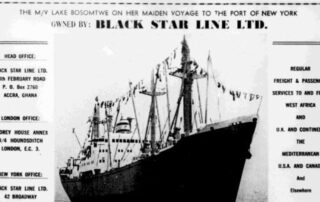
Black Star of Africa
Ghana Black Star NetworkThe Black Star of Africa is a black five-pointed star (★) symbolizing Africa in general and Ghana in particular. The Black Star Line, founded in 1919 by Marcus Garvey [...]


